



Door-to-Door Salesman
Just the other day, a pest control salesman knocked on my door. I always answer the door when I’m home, especially if it’s someone we don’t know—my wife prefers it that way.
There’s an interesting dynamic in my neighborhood—we all share a WhatsApp group chat. Before the salesman came to my door, my wife had already seen the neighbors’ comments about him making his way down the block.
All the neighbors basically said: “This guy is rude, he is lying, and he is disrespectful.”
My wife watched my interactions with the salesman on the Ring Video App and came away with a different perspective. She said your interaction with him was fine; he seemed respectful, and you were courteous. People have different perceptions of a salesman knocking on the door.
I wonder if people have different perceptions when the Savior knocks on the door of a person’s heart?
Doors make us curious; we may wonder what lies behind them. Some doors in life we may think are good to enter, but they may not be for us. But some doors are an invitation.
In this next section of Luke, Jesus speaks of a Narrow Door. Some translations use “Narrow Gate“; either way, there is some imagery in this section I want to take my time with.
Opening Prayer
Lord, we know your Word is living and active. It corrects, reveals, and revives us. Give us insight and a fresh perspective. Help us better understand your heart through your Word. Give us insight to understand your sacrifice and the open invitation to draw near to you by grace through faith. In Jesus’ Name, Amen.
“Here I am! I stand at the door and knock. If anyone hears my voice and opens the door, I will come in and eat with that person, and they with me.” - Revelation 3:20
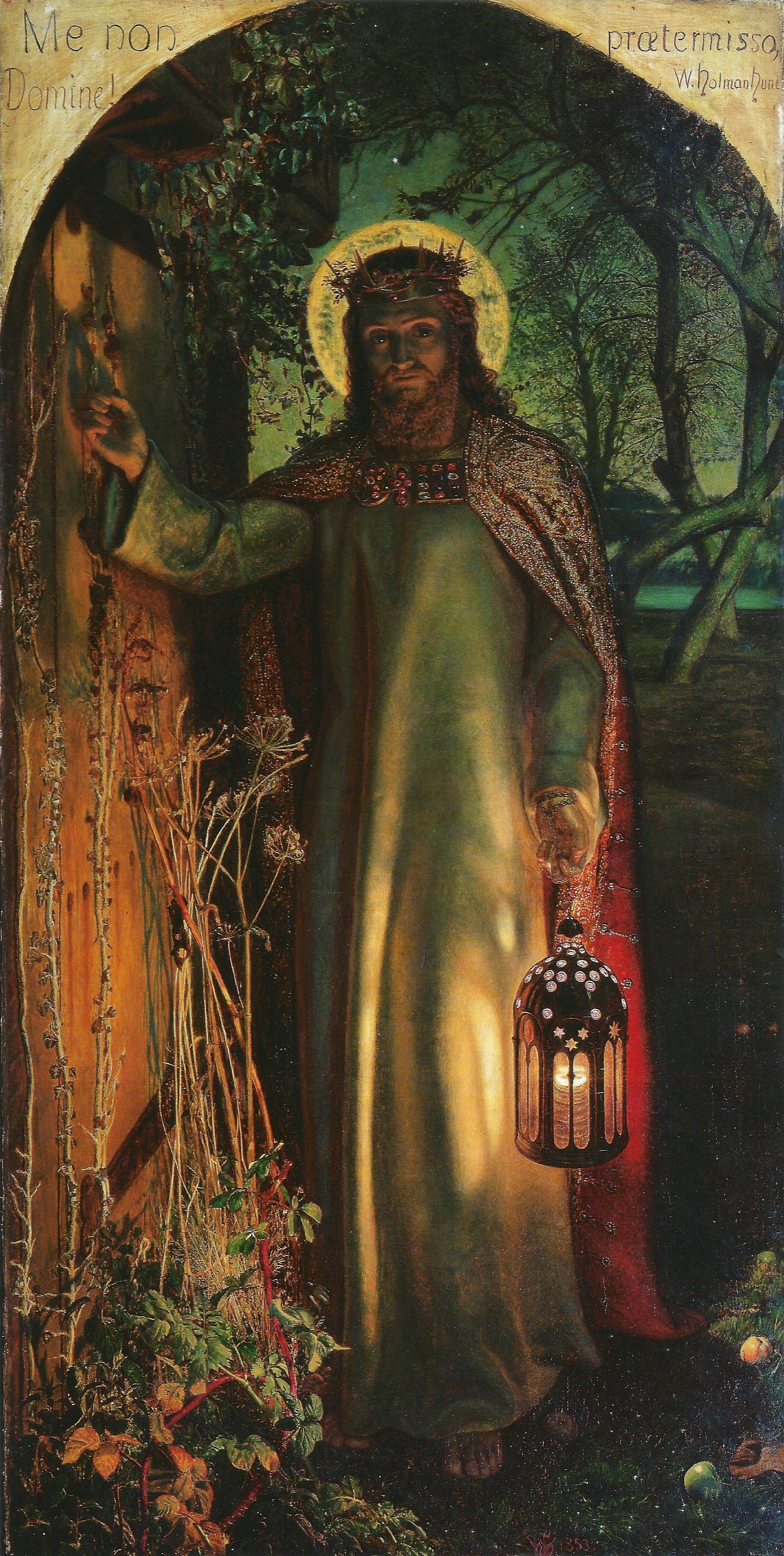
“The Light of the World” (1851–1854) by William Holman Hunt.
The Passage:
Luke 13:22-30
Then Jesus traveled throughout the towns and villages, teaching as He made His way toward Jerusalem. “Lord,” someone asked Him, “will only a few people be saved?”
Jesus answered, “Make every effort to enter through the narrow door. For many, I tell you, will try to enter and will not be able. After the master of the house gets up and shuts the door, you will stand outside knocking and saying, ‘Lord, open the door for us.’ But he will reply, ‘I do not know where you are from.’ Then you will say, ‘We ate and drank with you, and you taught in our streets.’ And he will answer, ‘I tell you, I do not know where you are from. Depart from me, all you evildoers.’
There will be weeping and gnashing of teeth when you see Abraham, Isaac, Jacob, and all the prophets in the kingdom of God, but you yourselves are thrown out. People will come from east and west and north and south, and will recline at the table in the kingdom of God. And indeed, some who are last will be first, and some who are first will be last.”
A.T.L.A.S. Outline
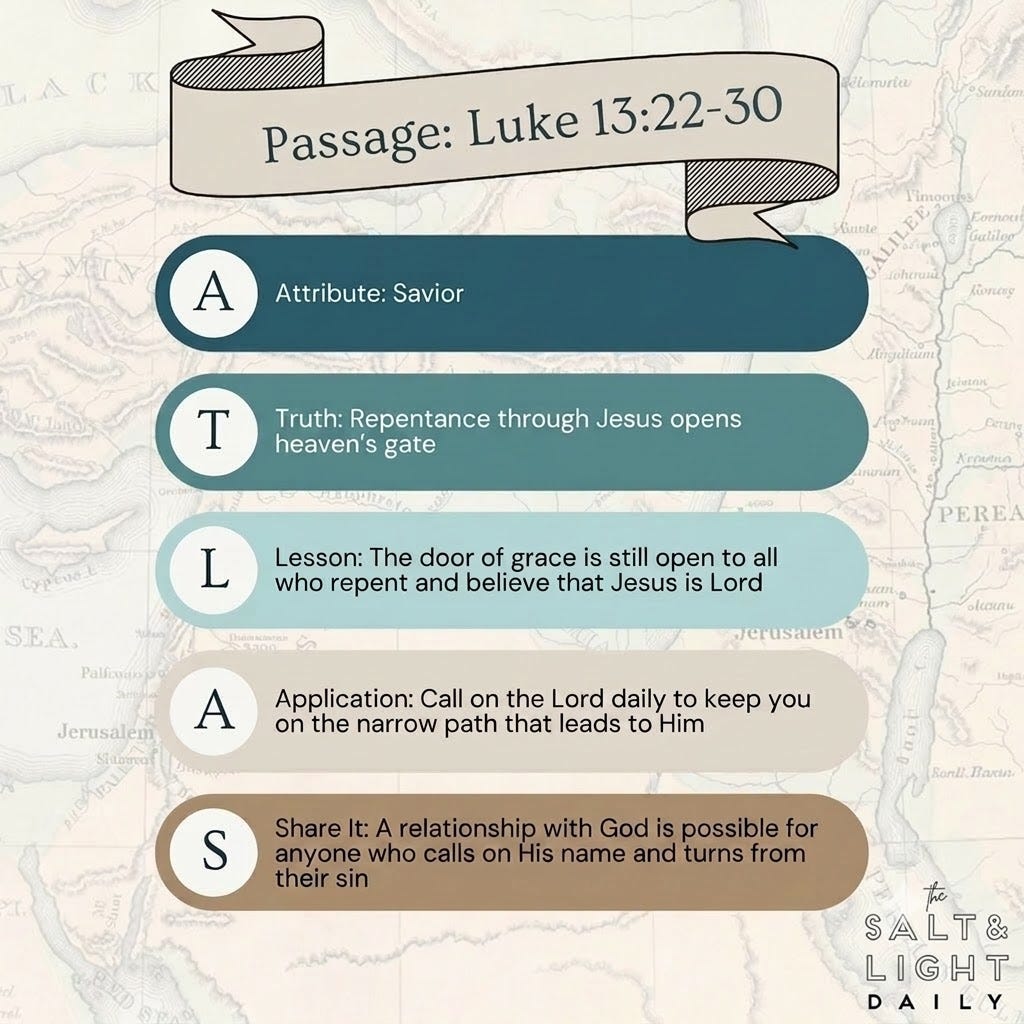
Understanding the Context
The theme of Luke chapter 13 is Repentance, but we will approach it from a slightly different angle.
Growing Opposition
Jesus is facing growing opposition to His ministry as He makes His way to Jerusalem. This journey is the Lamb of God making His final approach to voluntarily lay down His life for you, for me, and for every tongue, tribe, and nation. The door of His earthly life is closing soon, and the Cross is near. Luke earlier gives us a glimpse into the neighborhood dynamics happening in the gospel story:
“As the time approached for him to be taken up to heaven, Jesus resolutely set out for Jerusalem. And he sent messengers who went into a Samaritan village to get things ready for him; but the people there did not welcome him, because he was heading for Jerusalem. When the disciples James and John saw this, they asked, ‘Lord, do you want us to call fire down to destroy them?’ But Jesus turned and rebuked them, and they went to another village.” — Luke 9:51-56
The Samaritan village did not “welcome him.” Since Christ had always dealt tenderly with Samaritans, you would think He would receive a better reception. James and John noticed this and were offended.
Now, I like James and John. As someone who is protective of those I love, I can relate. They had a nickname: the “sons of thunder” (Mark 3:17). They were fiercely protective toward anyone they felt was a threat to someone they cared about. Notice their request to the Lord at the unwelcoming response of the village:
Lord, do you want us to call fire down to destroy them?
These brothers didn’t just want to leave a bad review on WhatsApp; they wanted to call down fire from heaven to wipe these people out! Now, it’s probably a good thing that we cannot call down fire from heaven. But I have met a few people in life, and I kind of wish I could call down a little thunder to awaken them to their need for repentance. How about you?
The Parable of The Narrow Way
On this journey to Jerusalem, Jesus is asked a pointed question, which appears to me to be a very honest one:
“Lord, are only a few people going to be saved?”
Remember, Jesus often spoke in stories to illustrate spiritual truths (Matthew 13:35). Jesus answers this question with a vivid picture: The Parable of the Narrow Way.
v. 24: A Command (“Make every effort...”)
vv. 25–29: An illustrative story & warning
v. 30: A proverbial warning about comparison
The imagery here is sharp, and the narrow path & door is intentional:
A master of a house.
A door that is closed.
People knocking from the outside.
The master refused entry.
A final separation between insiders and outsiders.
A Door That Is Shut: Retracing the Garden Path
In Luke 13, the word “door” is the Greek word thura, meaning an entrance, a gateway, or an opening. Some translations use the word “gate” instead. Both paint the same picture: an entrance represents access.
When Jesus talks about a “narrow door,” He is actually tapping into a storyline that runs throughout of the Bible.
Think back to the Garden of Eden. When Adam and Eve turned their back on God and chose sin, they were exiled. Genesis tells us exactly how God secured the perimeter:
“After he drove the man out, he placed on the east side of the Garden of Eden cherubim and a flaming sword flashing back and forth to guard the way to the tree of life.” — Genesis 3:24
When Adam and Eve walked out of God’s presence by moving East, the Garden gate was permanently shut.
Fast forward to the Tabernacle in the wilderness and later, Solomon’s Temple. When God gave the blueprints for His holy dwelling place, He intentionally designed it to mirror the layout of the lost Garden. Do you know what the most distinct feature of the Tabernacle and Temple perimeter was?
There was only one single entrance, and it faced directly East.
Think about the imagery of that walk. To come back into fellowship with God, a person literally had to turn their back on the East—the direction of exile, wandering, and self-reliance—and retrace Adam and Eve’s steps back into the sanctuary through that single entrance.
Jesus is the fulfillment of that single Gate. Since the exile episode in Eden, sin blocked the way back home. By dying on the cross, Jesus stepped right into the restricted path and became the open gate. Christ is the single, access point for us to walk back into the Father’s presence.
“I am the gate; whoever enters through me will be saved.” - John 10:9
"The narrow gate here is new birth - salvation by grace through faith. Jesus was warning the man to make sure he enters by this door."¹
A Final Thought
When that pest control salesman knocked on my door, my neighbors’ preconceived perceptions kept them from interacting with him at all.
When Jesus knocks on the door of your heart, what is your perception? Do you hear a Savior offering an invitation to a relationship?
The door is open today, but the passage reminds us that it will not stay open forever. Make every effort to enter. He is offering the invitation—will you open the door?
You are always welcome to knock on my door if you ever find yourself in the Upstate of South Carolina; just do me a favor and give me a quick heads-up before you come around.
Beloved, the only path that matters is the path that Jesus tells us to take.
Until next time, friends.
Endnotes/References:
William Holman Hunt, The Light of the World (1851–1854). Oil on canvas, Keble College, Oxford.
A.T.L.A.S. Outline by The Salt & Light Daily Substack.
James Strong, The New Strong's Expanded Exhaustive Concordance of the Bible, red letter ed., contrib. John R. Kohlenberger III (Nashville: Thomas Nelson Publishers, 2001), s.v. "Thura."
William MacDonald, Believer's Bible Commentary, 2nd ed. (Nashville: Thomas Nelson, 2016), 1371.¹


