

Progressive Sinners
Lessons from Luke 13:1-5

“Progress means getting nearer to the place you want to be. And if you have taken a wrong turn, then to go forward does not get you any nearer. If you are on the wrong road, progress means doing an about-turn and walking back to the right road; and in that case the man who turns back soonest is the most progressive man.”
— C.S. Lewis

Not long ago, my daughter and I went to Chick-fil-A to pick up sandwiches for our family. As I thought about this topic, I asked her, “When you hear the word ‘repent,’ what comes to mind?”
She answered, “It means I’m on the wrong path, not where God wants me, and I need to get on the right road.” To me, that’s a progressive response.
If repentance is like a road, it’s a narrow one.
Luke 13 opens up to cause us to reconsider our assumptions about labels, sin, suffering, and how we think about others and ourselves. The good news is that Jesus desires to set us on the right path, one that leads to Him.
Luke, who often focuses on healing, highlights spiritual health by mentioning the call to “repent” fourteen times more than any other biblical writer.
Jesus told the self-righteous, “It is not the healthy who need a doctor, but the sick. I have not come to call the righteous, but sinners, to repentance” (Luke 5:32).
The Trap of Labels
We live in a culture where people prefer to label others. If I told you I’ve lived in Pennsylvania, New Jersey, Florida, and South Carolina, your mind would instantly build a profile of me.
We do this not just with geography, religion, and politics, but also when we compare ourselves to others about sin. Each of us has our own way of judging. Even in Jesus’ time, religious leaders called him a friend of sinners and a glutton (Mt 11:19; Lk 7:34).
Remember the story of Jonah, he was bias in his mind against the Ninevites, he did not feel they were deserving nor would they be accepting of God’s grace.
Opening Prayer:
Lord, help us see your heart in your Word. Open our minds and feed our doubts and worries with your comforting promises for those of us who call you Father. In Christ’s Name, Amen.
Devotional Verses:
“At that time, some of those present told Jesus about the Galileans whose blood Pilate had mixed with their sacrifices. To this, He replied, “Do you think that these Galileans were worse sinners than all the other Galileans, because they suffered this way? No, I tell you. But unless you repent, you too will all perish. Or those eighteen who were killed when the tower of Siloam collapsed on them: Do you think that they were more sinful than all the others living in Jerusalem? No, I tell you. But unless you repent, you too will all perish.” - Luke 13:1-5
Context of the Passage
The crowds ask Jesus about a tragic story involving faithful Galileans and Pontius Pilate, the Roman leader in Judea. Pilate’s name is cited in the Bible over sixty times, marking his part in the Gospel story. The Gospel reveals that Pilate was divided, skeptical, and mainly concerned about self-preservation.
Now, Galilee, which included towns such as Bethsaida, Nazareth, Cana, and Capernaum, was where Jesus spent most of his time. The region was overlooked by the religious leaders. Eleven of the twelve disciples were from Galilee, except Judas Iscariot, who betrayed Him. The disciple Nathanael asked, “Can anything good come from Nazareth?” (John 1:46). Galilee was under Roman rule through Herod Antipas, known as the Tetrarch.
The crowds first tell the story of faithful Galileans who travel to Jerusalem to make sacrifices at the Temple. Tragedy struck when they met an unfortuntate fate when attacked by Roman soldiers sent by Pilate. The crowd assumes these Galileans must have done something wrong to deserve such a fate. It echoes the story of Job and the questions we all ask when faithful people suffer. Perhaps, they wonder, these Galileans weren’t as righteous as they seemed.
Wrong Thinking: The Need for Correction
Jesus asked two pointed questions to the crowds:
“Do you think that these Galileans were worse sinners than all the other Galileans, because they suffered this way?”
“Do you think that they were more sinful than all the others living in Jerusalem?”
The questions indicate that Jesus knows their wrong thinking; they wanted to connect suffering with a result of sinfulness. We can all make the same mistake of thinking that those who suffer tragedy or misfortune might be deserving, and we avoid confronting our shared need for grace. Perhaps a reading assignment in Job would of been helpful?
Jesus, explaining faith, tells the crowd twice, “No, I tell you,” to place emphasis that this mistaken thinking of comparison, labels, and pride in our faith does not lead to humility or repentance. True progress is found not in judging or mislabeling others, but in turning our own hearts back to God.
Pivoting to “Unless”
Jesus uses the word “unless” to shift the focus from others to ourselves. If you were about to take the wrong path, wouldn’t you want a warning?
The word “unless” is used throughout the Word to highlight a turning point.
Progress
In God’s view, there are no “better” or “worse” sinners. There are only Repentant Sinners (Progressive) and Unrepentant Sinners (Unprogressive).
True repentance is the beatification of the soul, the process of being made beautiful and holy by turning toward the Light. Repentance is the universal call for every sinner to knock on the door of grace; it is the moment we stop trying to fix the old, broken road and finally step onto the right one. Heaven doesn’t just watch this progress; it celebrates it. As Jesus tells us in Luke 15:7:
“I tell you that in the same way, there will be more joy in heaven over one sinner who repents than over ninety-nine righteous persons who need no repentance.”

Perspectives on Repentance
From the Heidelberg Catechism: What is true repentance or conversion of man? It is the dying of the old nature and the coming to life of the new.
From the Westminster Shorter Catechism: What does it mean to repent and gain eternal life? Repentance that leads to life is a saving grace, where a sinner, with a true understanding of their sin and an appreciation of God’s mercy in Christ, does, with grief and hatred of their sin, turn away from it and to God with a full intention and effort to live a new life of obedience.
“Today sin is called sickness, so people think it requires therapy, not repentance”
- John MacArthur.
A.T.L.A.S. Outline
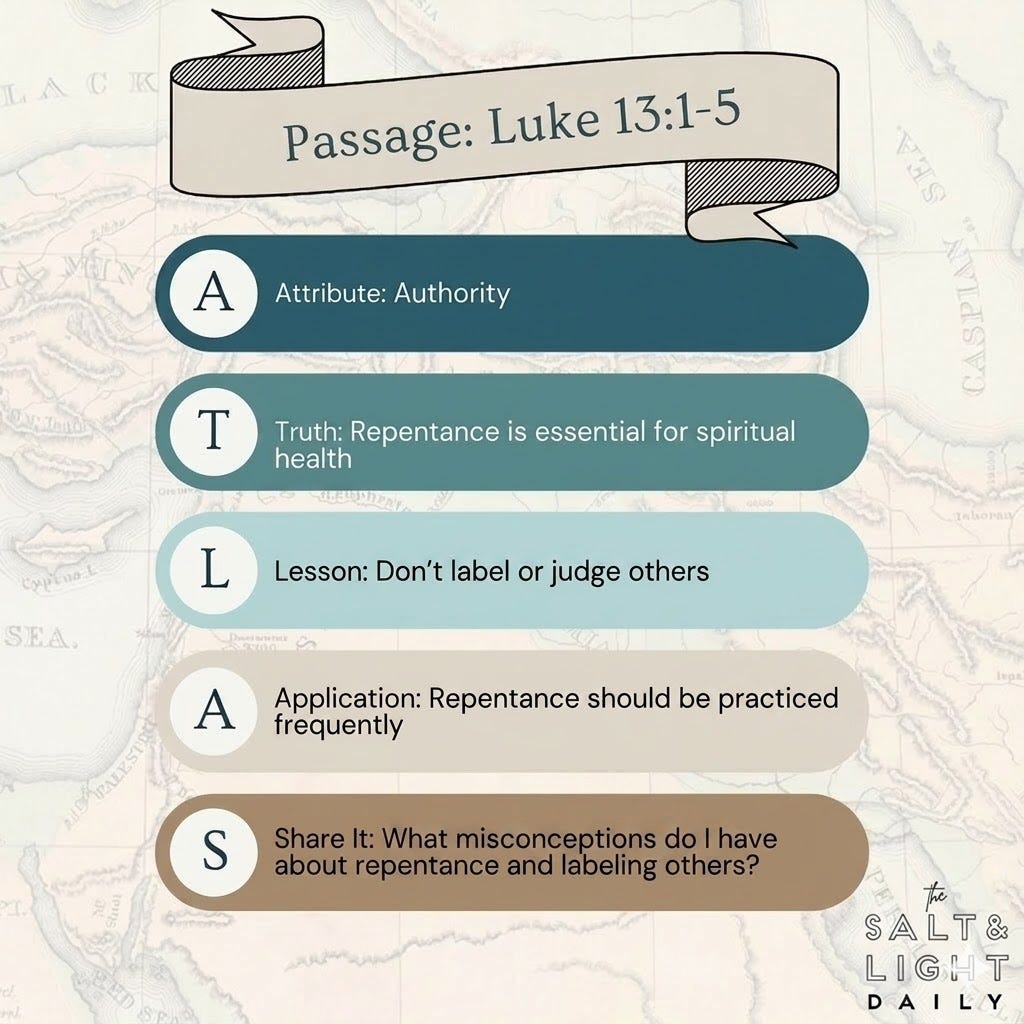
Keep this devotional salty & inspiring. ☕
Endnotes/References:
Repent (mentioned 14 times): Luke 3:3, 3:8, 5:31–32, 10:13, 11:32, 13:3, 13:5, 15:7, 15:10, 16:30, 17:3–4, 24:47 (BSB).
Scripture quotations are from the Berean Standard Bible (BSB)®.
Heidelberg Catechism (1563), Lord’s Day 33, Q. 88. Scripture references: Rom. 6:1–11; 1 Cor. 5:7; 2 Cor. 5:17; Eph. 4:22–24; Col. 3:5–10.
Westminster Shorter Catechism (1647), Q. 87. Scripture references: Acts 2:37–38, 11:18; Joel 2:12; Jer. 3:22, 31:18–19; Ezek. 36:31; 2 Cor. 7:11; Isa. 1:16–17.
Paul, I love this so much!!!! So well formatted in thought and in references. “There no such thing as better or worse sinners only there is unrepentant sinners and repentant sinners”
This I’ve noticed in my own life to be true. God is not scaling my sin, He’s only wanting me to simply turn back toward Him in whatever regard and abandon the erred way.
"Repentance is...the moment we stop trying to fix the old, broken road and finally step onto the right one."--this is SO good!
I have never considered repentance and the narrow road or progressive and unprogressive in this way before, but what a great illustration. Thanks for sharing, Paul!