

His Hands
Lessons from Luke 13:10-17

Hands Tell A Story
I have a scar on my right hand from when I was thirteen years old, trying to climb a chain-link fence at Rock Lake Middle School in Longwood, Florida. I needed twenty-five stitches. The pain was memorable enough that I never tried climbing another fence again.
Your hands tell a story, too.
And so do His.
Throughout the Gospels, Jesus touched people no one else wanted to touch. Lepers. The blind. The broken. The forgotten. Those with little faith. The writers of the Gospels paid close attention to His hands because everyone Jesus touched was healed and restored.
Touch is central to both healing and Jesus’s ministry.
In the Gospels, the phrase “His Hands“ appears more than 20 times and the writers carefully observed how Jesus touched people. The Gospels also tell us that Jesus was a carpenter by trade. I sometimes wonder what His hands looked like—were they rough from years of work, yet strong for healing?
“At sunset, all who were ill with various diseases were brought to Jesus, and laying His hands on each one, He healed them.” – Luke 4:40

“Like clay in the hand of the potter, so are you in my hand…” - Jeremiah 18:6
Opening Prayer:
Lord, help us as we read and wrestle with your Word. We know you care about every detail of our lives, even the areas we try to hide. Give us insight as we read this story, help us recognize your unique touch in our lives, free us from a spirit of legalism, and help us trust you with every next step. In Jesus’ Name, Amen.
Luke 13:10-17:
One Sabbath, Jesus was teaching in one of the synagogues, and a woman there had been disabled by a spirit for eighteen years. She was hunched over and could not stand up straight. When Jesus saw her, He called her over and said, “Woman, you are set free from your disability.” Then He placed His hands on her, and immediately she straightened up and began to glorify God.
But the synagogue leader was indignant that Jesus had healed on the Sabbath. “There are six days for work,” he told the crowd. “So come and be healed on those days and not on the Sabbath.”
“You hypocrites!” the Lord replied. “Does not each of you on the Sabbath untie his ox or donkey from the stall and lead it to water? Then should not this daughter of Abraham, whom Satan has kept bound for eighteen long years, be released from her bondage on the Sabbath day?”
When Jesus said this, all His adversaries were humiliated. And the whole crowd rejoiced at all the glorious things He was doing.
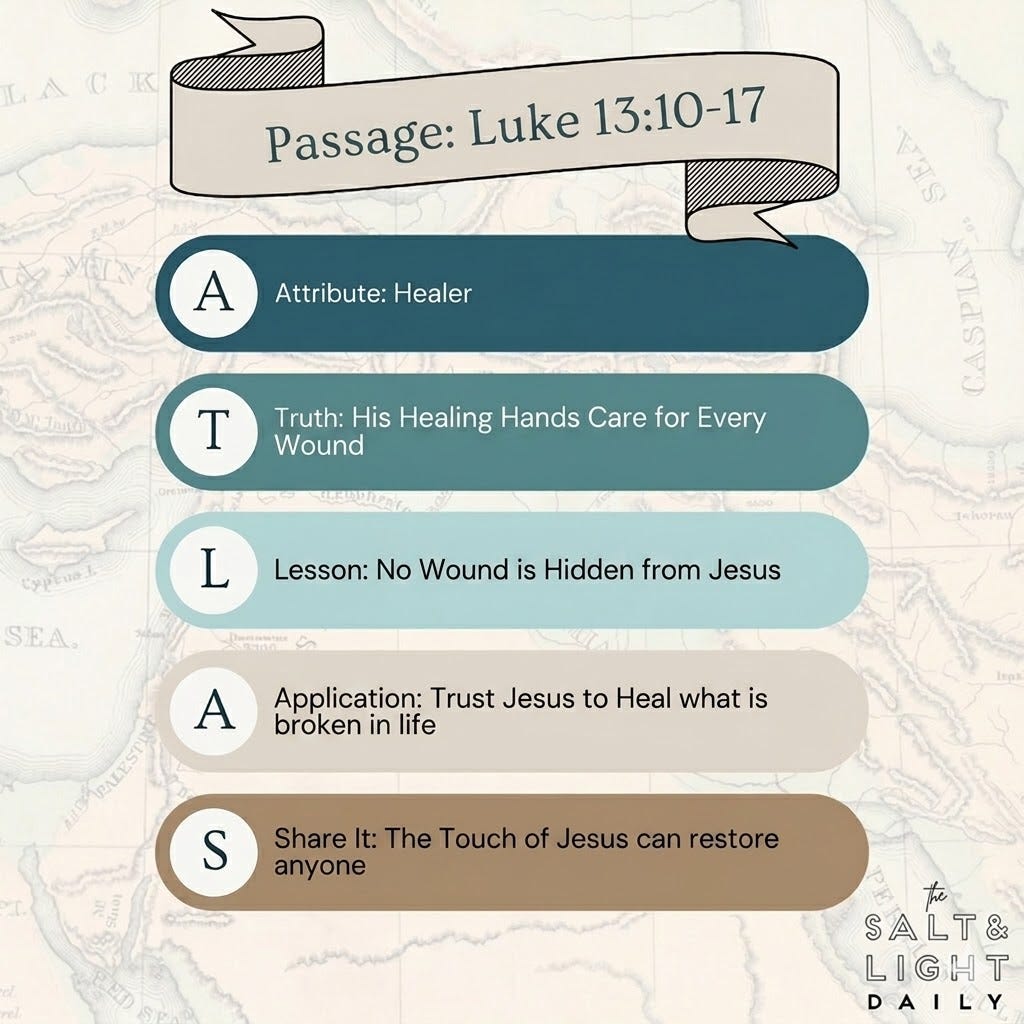
A.T.L.A.S. Outline
Eighteen Years: Suffering and Maturity
Eighteen years is a long time to hurt. In many cultures, eighteen is the age of maturity—when a person is recognized as an adult. In Scripture, long seasons of pain often produce spiritual maturity.
James 1:2–4 reminds us:
“Consider it pure joy, my brothers and sisters, whenever you face trials of many kinds, because you know that the testing of your faith produces perseverance. Let perseverance finish its work so that you may be mature and complete, not lacking anything.”
This woman’s eighteen years of suffering may mirror the journey to maturity that God forges through perseverance and faithfulness in pain. Her faith is admirable—she kept coming to the synagogue despite her pain and disappointment. Many would have given up, but she developed endurance.
There are moments when physical pain seems easier to endure than loneliness. In 2019, Parkland Hospital in Dallas found that eighty patients visited the ER more than 5,000 times in a year, not for disease, but for loneliness. People who are hurting want someone to notice.
His Hands of Compassion
Luke tells us Jesus placed His hands on her, and immediately she straightened up and praised God. Jesus could have healed her with a word, but He chose to touch.
In the story, Jesus’ hands communicate more than power; they communicate compassion. The religious leaders saw rules, not broken people. They didn’t know her name, but Jesus did. He called her a “daughter of Abraham.”
It is worth noting that Jesus’ argument against the religious leader is rooted in common sense. They should not care more about animals and themselves than they do about others.
In The Believer’s Bible Commentary, Macdonald writes, “The Lord reproved his hypocrisy (Synagogue Ruler) and that of the other leaders. He reminded them that they didn’t hesitate to loosen an ox or donkey from the stall on the sabbath in order to let it drink water. If they showed such consideration for …animals on the Sabbath, was it wrong for Jesus to perform an act of healing on this woman who was a daughter of Abraham? The expression, ‘a daughter of Abraham,’ indicates not only that she was…a true believer, a woman of faith. The curvature of the spine was caused by Satan. We know from other parts of the Bible that some sicknesses are the result of Satanic activity. Job’s boils were inflicted by Satan. Paul’s thorn in the flesh was a messenger of Satan to buffet him.
In Closing
The Sabbath, intended for rest and renewal, was not for cold religious duty. Hurting people matter to Him; they should matter to us. It’s fine to be concerned about God’s Word, but if our aim is just performance and appearances, we might lose sight of those just needing an encouraging touch that someone cares.
Reflection
Who do you know who needs a healing or encouraging touch today?
Do you have a scar that has led you to Jesus?
Do you believe Jesus still sees you in your personal hurting?
Endnotes/References:
His Hands: Matt. 8:3; 14:31; 19:13; 19:15; Mark 1:41; 6:5; 7:32; 8:23; 8:25; 9:27; 10:13; 10:16; Luke 4:40; 5:13; 13:13; 18:15; 24:40; 24:50; John 3:35; 20:20; 20:25.
William MacDonald, Believer’s Bible Commentary (Nashville: Thomas Nelson Publishers, 1995), 1423, on Luke 13.
Teresa Woodard, “80 People Went to Dallas Emergency Rooms 5,139 Times in a Year — Usually Because They Were Lonely,” WFAA, May 27, 2019, .
The blessing of touch is a gift. Jesus used His hands to heal…sometimes when we reach out and touch someone it heals their souls!
Great article Christopher!
I see a lot of symbolism in Jesus’ use of touch. Communion with God’s perfection is our ultimate source of healing and completion. Of course, this is what the Incarnation is all about.
While God can heal at a word, and sometimes did, like with the Nobleman’s son in John 4, and the Centurion’s servant in Luke 7, it is oneness with God that brings the fullness of life. John 15-17.
I think God’s touch is emphasized in the Gospels to help teach us this all important truth. Thanks for such a thoughtful essay this week.